Data Analytics / Machine Learning
Film Industry Analytics: Director Gender & Critical Reception
An end-to-end analytics project investigating whether director gender is associated with measurable differences in how films are received by critics and audiences, and how those films perform financially. The analysis combines IMDb metadata with Metacritic scores across 465 films released between 2015 and 2020, layering in NLP-based sentiment analysis of movie descriptions and OLS regression to test the relationships statistically.
The problem
Conversations about representation in film often reference critical and commercial outcomes, but rigorous, dataset-backed comparisons are less common. I wanted to see what an honest statistical look at the public data would actually show - and whether any apparent effects survived controlling for confounding variables.
Research questions
- Q1
Do female-directed films receive different critic scores than male/other-directed films?
- Q2
Do audience ratings differ across the same groups?
- Q3
Are there systematic budget differences?
- Q4
Does director gender appear to influence return on investment?
- Q5
Can sentiment analysis of movie descriptions predict critic reception?
Approach
- 01
Retrieved and cleaned movie metadata from IMDb and critic data from Metacritic, then merged on movie identifiers to produce a 465-film working dataset spanning 2015–2020.
- 02
Identified director gender through manual validation against external sources to keep the labeling defensible.
- 03
Ran descriptive statistical analysis across critic scores, audience ratings, budgets, and ROI, broken out by director gender and by genre.
- 04
Applied a Hugging Face transformer model to classify the sentiment of each film's description as a candidate predictor.
- 05
Built OLS regression models to test whether director gender remained a significant predictor of critic scores after controlling for description sentiment.
Findings
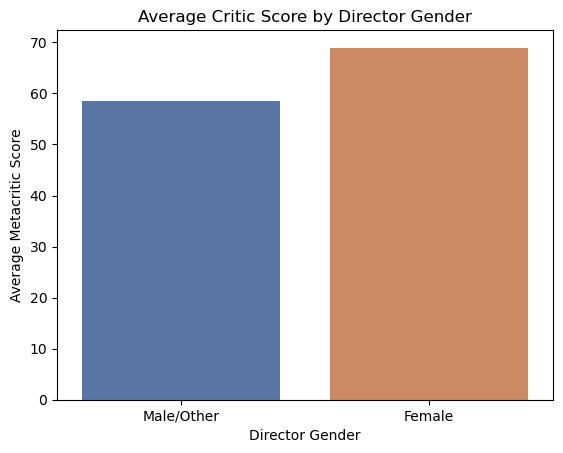
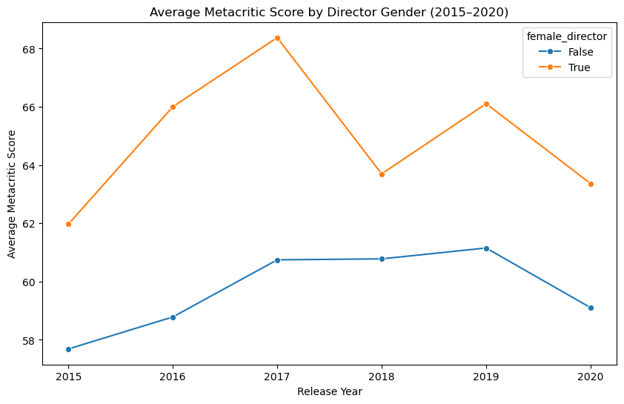
Female-directed films received substantially higher Metacritic scores on average than male/other-directed films, while audience ratings were broadly similar.
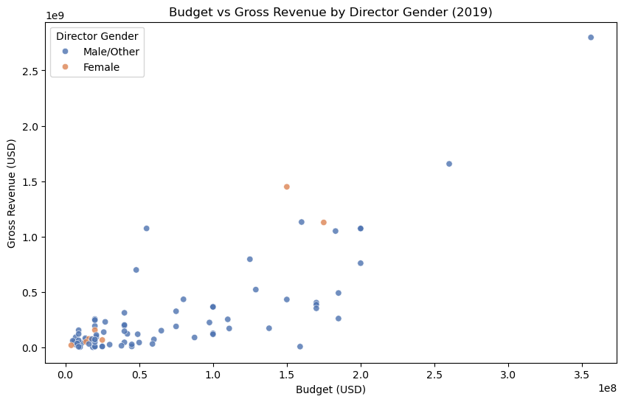
Female-directed films were produced with smaller budgets on average across the 2015–2020 window.
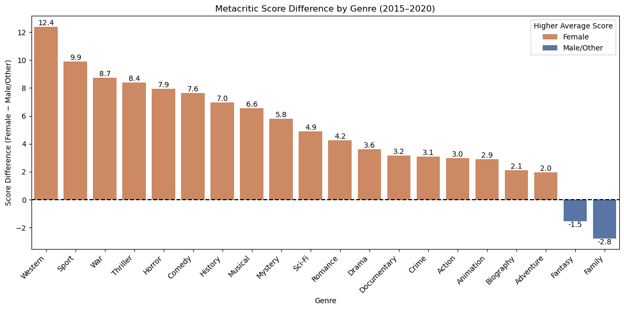
Higher critic scores for female-directed films appeared in 18 of 20 genres - not concentrated in any single category, including traditionally male-dominated ones like action, crime, sci-fi, horror, and war.
The 2019 ROI advantage for female-directed films did not hold consistently across 2015–2020, suggesting that year was a strong outlier rather than evidence of a sustained profitability gap.
Description sentiment was not a statistically significant predictor of critic scores, and including it in the regression did not meaningfully change the director-gender effect.
Regression analysis
Model 1 - Director Gender
| Variable | Coefficient | p-value |
|---|---|---|
| Female Director | +10.47 | 0.003 |
Finding · Films directed by women received approximately 10.5 higher Metacritic points on average than films directed by male/other directors. The effect was statistically significant.
Model 2 - Director Gender + Description Sentiment
| Variable | Coefficient | p-value |
|---|---|---|
| Female Director | +10.19 | 0.004 |
| Neutral Sentiment | +2.10 | 0.360 |
| Positive Sentiment | -2.31 | 0.435 |
Finding · After controlling for description sentiment, the director-gender effect remained nearly unchanged. Sentiment variables were not statistically significant predictors of critic scores.
Visualizations
What's next
This analysis demonstrates correlation, not causation. Useful extensions would be incorporating production-company effects, opening-weekend marketing spend, and a wider time range to test whether the score gap is narrowing or stable over time.